
Sudden death screening · Sibiu
Sudden death screening in Sibiu, for young people and athletes under 35
The conditions that cause sudden death in young people are silent, but most of them leave marks on the electrocardiogram. The trace is read against the international criteria for athletes, which separate a trained heart from a diseased one.
What sudden death screening is
Sudden cardiac death in a young and apparently healthy person almost always has a cause that was already there. A disease of the heart muscle, a disorder of the heart's electrical system, or an abnormality the person was born with. Unlike a heart attack in middle age, the disease was not built up over time. It was present, silent, sometimes from birth.
Screening starts from the observation that many of these conditions leave marks on the electrocardiogram before they cause any symptom. Hypertrophic cardiomyopathy changes the trace in more than nine out of ten patients. Arrhythmogenic cardiomyopathy, in more than eight out of ten. Long QT syndrome, Brugada syndrome and ventricular preexcitation show up directly, as recognisable patterns.
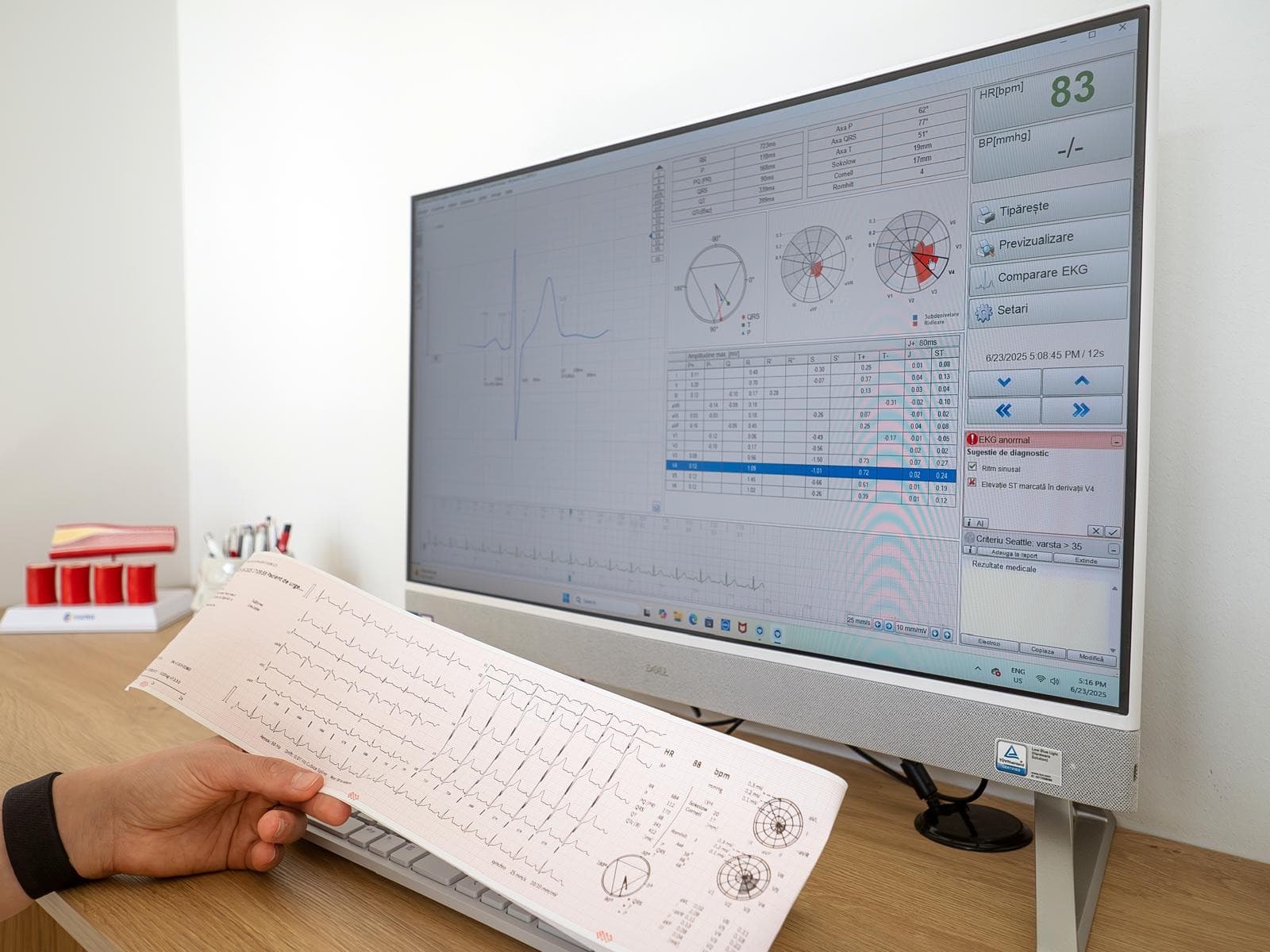
At the Biocord practice, the assessment means a 12 lead electrocardiogram, read by the doctor and analysed alongside the BTL SDS module, short for Sudden Death Screening. The module applies the Seattle criteria automatically, the international set of rules for reading the trace in young people and in athletes.
The point of those criteria is to separate two things that look alike on graph paper. The heart of someone who trains seriously does change: the pulse slows, the walls thicken, the chambers widen, and the trace looks different from a sedentary person's. None of that is disease. The Seattle criteria state exactly which changes are adaptation to training and which call for further investigation.
The difference shows in the numbers. Under the 2005 European criteria, up to 16% of the athletes assessed were sent for further tests for nothing. The current international criteria brought the false alarm rate down to between 1.3% and 6.8%. That means fewer young people frightened without reason, and fewer pulled out of sport for nothing.
The assessment is for people up to the age of 35. Above that age the causes of sudden death change, and with them the investigation that fits.
Who has reason to do it
This is not an investigation for everyone, and it is not done out of curiosity. It makes sense where the risk is higher than in the rest of the population, whether because of the effort, because of what has happened in the family, or because of symptoms that were never explained.
- You are under 35 and you play competitive sport, at a club or in competitions
- You train hard on your own, run half marathons, do crossfit or endurance cycling
- You are about to start a demanding training programme and want to know where you stand
- Someone in your close family died suddenly before the age of 50, especially if the reason was never established
- Your family has a history of cardiomyopathy, long QT syndrome, Brugada syndrome or another inherited heart condition
- You have fainted during physical effort, not after it and not in the heat
- You get palpitations that come on with effort rather than at rest, or irregular beats that wake you
- You get chest pain, or you are more short of breath than the effort would explain
- An ECG done elsewhere came back with something unclear and you were told to show it to a cardiologist
Fainting during physical effort is the symptom that does not wait. If you fainted while you were actually running, swimming or lifting, call us before booking online, so we can see you quickly.
How the assessment goes
It takes around twenty minutes, it does not hurt, there are no needles and you do not need to come on an empty stomach.
The conversation about you and your family
I ask what sport you play and for how long, whether you have ever fainted or had palpitations or chest pain on exertion, and what medicines and supplements you take. Then we go through the family: who died suddenly and at what age, who has a known heart condition. This part is not a formality. A family history of sudden death under 50 changes the reading of the trace on its own.
Recording the trace
Ten electrodes go on, on the chest, the arms and the legs, and the machine records the electrical activity of the heart from twelve directions at once. You lie down and relax. You feel no current, it does not hurt, and the recording itself takes under a minute.
Analysis against the Seattle criteria
The SDS module goes through the trace and sorts it against the international criteria for young people: normal changes, borderline changes, and changes that call for investigation. In the middle category the rule is that two such changes must appear together to justify a next step. A single borderline change on its own does not.
The doctor's reading
The computer analysis decides nothing. I read the trace and set it against what you told me at the start, against your age and against the sport you play. The same trace means something different in a 19 year old footballer and in a sedentary 30 year old whose uncle died suddenly at 40.
The explanation and what you take home
I show you the trace on paper and explain what can be seen. You leave with the written interpretation, the conclusion and, where it applies, what comes next and in what order. If everything is in order, I also tell you when it would make sense to repeat it.
Why the age of 35 matters
Under 35, sudden death has causes that are mostly inherited or structural and present from birth: diseases of the heart muscle, disorders of the ion channels, abnormalities in where the coronary arteries begin. Over 35, the cause becomes, overwhelmingly, coronary atherosclerosis, the same disease that causes heart attacks.
That is why the right investigation differs. Under 35, the electrocardiogram gives the best ratio between what it catches and what it costs, because inherited conditions leave an electrical signature. Over 35, what matters is coronary risk assessment: blood pressure, cholesterol, blood sugar, smoking, history, plus tests for ischaemia where they are justified.
The 2020 European guideline states plainly that in asymptomatic adults over 35, routine testing for ischaemia has low predictive value and produces many false alarms, so it is not recommended as screening. This is a question of accuracy, not of cost.
The frequency of events follows the same line. Under 35, sudden death in athletes occurs at an incidence of the order of one per hundred thousand people per year. Over 35 the figure rises several times over. It is rare in both cases, but not equally rare, and not for the same reasons.
If you are over 35 and concerned about cardiovascular risk, the investigation that fits is not this one but a cardiology consultation with risk assessment, completed where symptoms call for it with an exercise stress test.
What an electrocardiogram cannot see
This is the part most screening pages skip, which is exactly why it belongs first. A normal result lowers the risk. It does not remove it, and it is not a certificate that nothing can happen to you.
Around 60% of the conditions associated with sudden death are thought to be detectable on an electrocardiogram. The rest, roughly four in ten, are not.
Congenital coronary anomalies, meaning heart arteries that start in the wrong place, are the most important cause that escapes an ECG entirely. They account for a far from negligible share of sudden deaths in young people and usually produce no change in the trace at all.
Catecholaminergic polymorphic ventricular tachycardia, shortened to CPVT, has a normal resting electrocardiogram by definition. The arrhythmia appears only with effort or emotion. Myocarditis often gives a normal or non specific trace. Aortic conditions such as Marfan syndrome, or a bicuspid aortic valve with dilatation, are not visible electrically at all.
Commotio cordis, the heart stopping after a blow to the chest landing in exactly the wrong fraction of a second of the cardiac cycle, is not a disease. It is a mechanical accident, and no screening anywhere can anticipate it.
There is one more limit, of a different kind: the trace says what is happening today. Inherited conditions express themselves in an age dependent way, and a heart with a cardiomyopathy at a very early stage can give a clean trace. That is why, for people who continue in competitive sport, the assessment is repeated periodically rather than done once in a lifetime.
Honest to the end: adding echocardiography to screening does not close the gap. In a study of more than eleven thousand athletes, only four had a normal history, clinical examination and ECG while echocardiography still found something. And equally honest: no randomised trial has yet shown that pre participation screening lowers mortality.
Does screening actually work
The strongest argument comes from Italy, the only country to have made screening compulsory by law, since 1982. In the Veneto region, the incidence of sudden death in athletes fell from 3.6 per 100,000 people per year in the early eighties to 0.4 per 100,000 in the middle of the two thousands. A fall of almost nine tenths, followed in the same population with the same methodology.
The counterargument comes from Israel, which also introduced compulsory screening, in 1997. There, the incidence in the decade before the law and the decade after it were practically identical. The difference between the two experiences is not fully explained.
Because of that, Europe and the United States arrived at different recommendations. The European Society of Cardiology, along with FIFA and the International Olympic Committee, recommends history, clinical examination and a 12 lead electrocardiogram. The American associations do not recommend the electrocardiogram as universal screening, but targeted history taking and physical examination.
What neither side disputes is that the electrocardiogram catches more than questions and a stethoscope. History and clinical examination on their own identify under half of the cases. The European guideline says it directly: the trace is abnormal in more than 80% of patients with the conditions that most often cause sudden death in the young.
The practice follows the European model, because that is where we are and because that is where the criteria for reading the trace were written.
What happens after an abnormal trace
A trace classed as abnormal is not a diagnosis. It is an indication that we need to look further, and nothing more. Most of these traces end with a reassuring explanation.
The next step depends on what changed. A suspicion of thickened walls leads to echocardiography, which is done here, on the same day if there is room in the schedule. A suspicion of a rhythm disturbance leads to Holter monitoring, also at the practice. When the question is how the heart behaves under effort, an exercise stress test on the cycle ergometer follows.
There are also situations that go beyond what a cardiology practice can do: cardiac MRI, genetic testing, assessment at an electrophysiology centre. My role then is to tell you clearly where you need to go and why, not to walk you through intermediate tests.
If a condition is indeed confirmed, the decision about sport is neither automatic nor brutal. Some diagnoses allow the activity to continue with monitoring, others call for a change in intensity, few require stopping. That conversation happens with a diagnosis on the table, not with a suspicion.
And if someone in the family died suddenly and young, screening first degree relatives, meaning parents, siblings and children, is one of the best supported indications in the whole field. Inherited conditions do not stop at one person in a family.
Prices
| Service | Price |
|---|---|
| Cardiology consultation + ECG | 400 lei |
| Cardiology consultation + ECG + echocardiography | 620 lei |
| Cardiology follow-up + ECG | 300 lei |
| Echocardiographyincludes an orientative assessment of the liver, the carotid arteries and the thyroid | 400 lei |
| Holter ECG monitoring24 hours | 370 lei |
| Ambulatory blood pressure monitoring (ABPM)24 hours | 370 lei |
| Exercise stress test on a cycle ergometer | 450 lei |
| Body composition analysis | 100 lei |
| Ankle-brachial index (ABI)with interpretation | 100 lei |
| Electrocardiogram (ECG) | 100 lei |
| ECG + SDS (sudden death screening)extended BTL assessment, for people up to the age of 35 | 150 lei |
| Intravenous Ferinject 500 mgmedication and medical supervision included | 800 lei |
| Intravenous vitamin C (Pascorbin 7.5 g)product and medical supervision included | 350 lei |
You have seen the prices. Shall we go ahead?
Tell us what brings you to a cardiologist and we will suggest a time that works for you.
Frequently asked questions
How much does the ECG with the SDS module cost?
Do you issue sports medical certificates?
From what age can it be done?
What does SDS stand for?
Does a normal result mean I am not at risk?
Does it hurt, or involve any needles?
How do I prepare?
What is athlete's heart and why does it matter here?
Do I need to repeat the assessment?
Someone in my family died suddenly. Is an ECG enough?
I fainted once during training. Is that serious?
Can it be done in the same visit as the consultation?
Do I need a referral?
Sudden death screening in Sibiu
The Biocord practice is at Strada Ion Agârbiceanu 11, Sibiu, in the Turnisor neighbourhood.
Phone: 0771 193 295
Email: bio.cord@yahoo.com
Appointments are made by phone or through the form on this site. We confirm the time before you come.
Open in Google Maps
Services that go together with this one
- Electrocardiogram (ECG)The basic test of the heart: a few minutes, with no discomfort. Its value lies in the reading, that is, in what your tracing means alongside the rest of your story.
- EchocardiographyA heart ultrasound shows how your heart looks and how it works. In the same session we take a preliminary look at the liver, the carotid arteries and, when needed, the thyroid, at no separate cost.
- Cardiology consultationA consultation that does not stop at the reason you came in. We go through your history, your test results, your lifestyle and your risk factors, then build a long term prevention plan together.

Book sudden death screening
We confirm the time by phone and tell you whether any preparation is needed.